The R01: What Most Advisor Funding Actually Looks Like
The standard NIH research grant is called an R01. When a professor says "I have NIH funding," they almost always mean an R01. There are 6,026 active R01s in the FY2026 data, and understanding how they work tells you almost everything you need to know about lab stability.
R01s run in 5-year cycles. They're not guaranteed to renew — the renewal process is competitive, with roughly a 50% success rate. At the end of each cycle, the PI submits a renewal application and waits. A lab in Year 5 of its only R01 is in that waiting period right now.
Here's how the entire FY2026 R01 pool breaks down by stability:
| Stability Tier | Grants | Definition |
|---|
| Stable | 1,967 (33%) | End date ≥ 2029 |
| Mid-range | 3,293 (55%) | Ends 2027–2028 |
| Expiring | 766 (13%) | Ends in 2026 |
Source: NIH RePORTER FY2026 export · 6,026 active R01 grants
Reading the Grant Cycle: What "Support Year" Tells You
Every NIH grant record lists a Support Year — which year of the 5-year cycle the grant is currently in. This single number is one of the most useful signals available to a PhD applicant, and almost no one talks about it.
The table below shows how support year correlates with stability. The pattern is stark: virtually all Year 1–2 grants run through 2029 or later. Virtually all expiring grants are in Years 4–5.
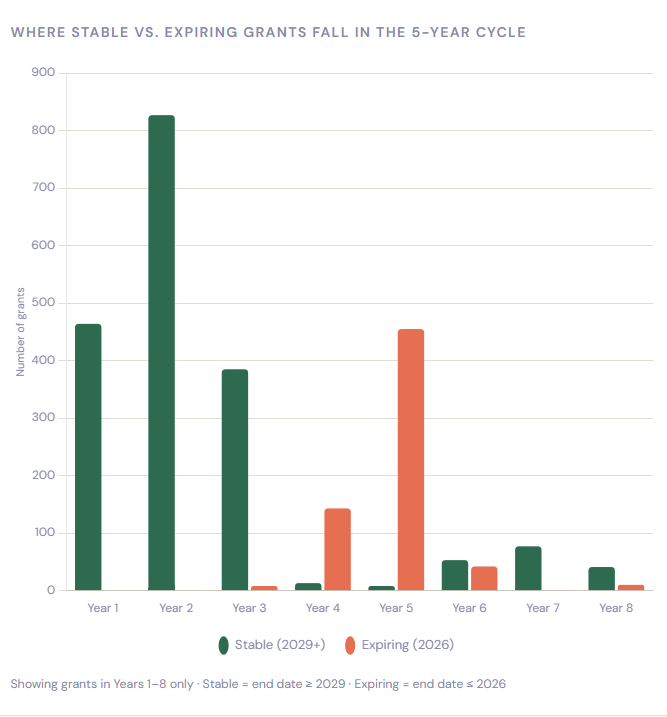
What this means in practice:
Year 1–2: Maximum runway. The grant was just awarded or recently renewed. This is the sweet spot — 4 to 5 years of funded research ahead of them, which covers most PhD timelines.
Year 3–4: Still solid, but the advisor is likely beginning to write their renewal application. Lab bandwidth may tighten slightly.
Year 5: The cycle is ending. Renewal is pending or about to be submitted. High uncertainty — not a dealbreaker, but something to ask about directly.
Watch for this: Of the 766 R01s expiring in 2026, 455 are in Year 5 — they've run their full cycle and are at the renewal decision point right now. Another 143 are in Year 4, expiring partway through the year.
Which Research Fields Have the Most Stable Funding?
Funding stability isn't uniform across research areas. The NIH's 27 Institutes each fund different disease areas, and their grant portfolios are at different points in their respective cycles. Here's how stability rates compare across the major biomedical domains:
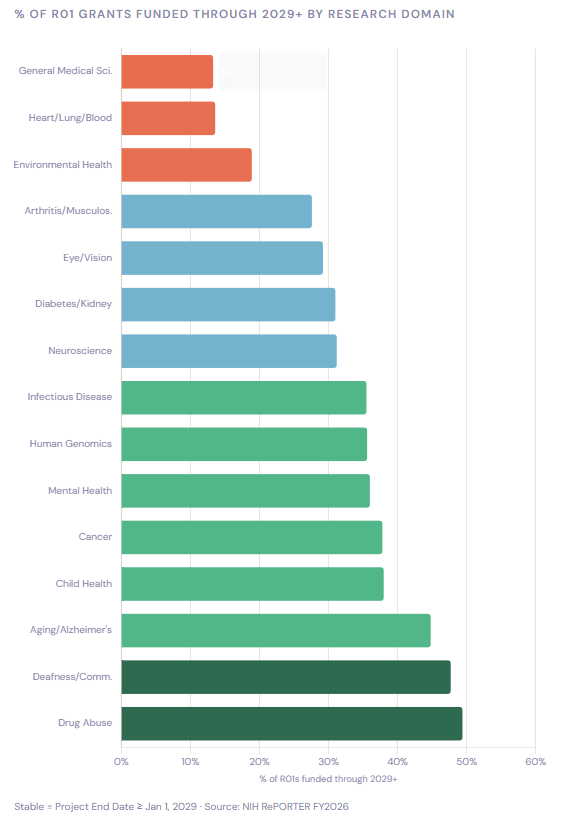
The standouts: Drug Abuse (49%), Deafness/Communication (48%), and Aging/Alzheimer's (45%) have the highest proportion of stable R01s in the current cycle. Nearly half of active grants in these fields run through 2029 or beyond.
At the other end: General Medical Sciences (13%) and Heart/Lung/Blood (14%) have the lowest stability rates — not because those fields are less funded, but because a larger share of their active grants happen to be mid-to-late in the current cycle.
If you're choosing between two labs with similar research fit, and one is in a field with a 45% stability rate versus 14%, that's a meaningful signal worth weighing.
The R35: A More Stable Grant Type Worth Knowing
Beyond the R01, NIH offers a longer-term award called the R35 (sometimes called a MIRA grant — Maximizing Investigators' Research Award). It's designed to give established, high-performing investigators more flexible, sustained funding over a longer horizon.
If your potential advisor holds an R35, that's a strong stability signal:
| Metric | Value |
|---|
| % of active R35s funded through 2029+ | 63% |
| Active R35 grants in FY2026 | 692 |
| Median annual R35 award | $432,000 |
Compare that 63% R35 stability rate to the 33% stability rate for R01s. An advisor with an R35 has nearly twice the odds of being in a stable funding window — and it indicates NIH has made a longer-term institutional bet on that researcher.
The "Sweet Spot" Labs: 1,291 Newly Funded R01s Through 2029
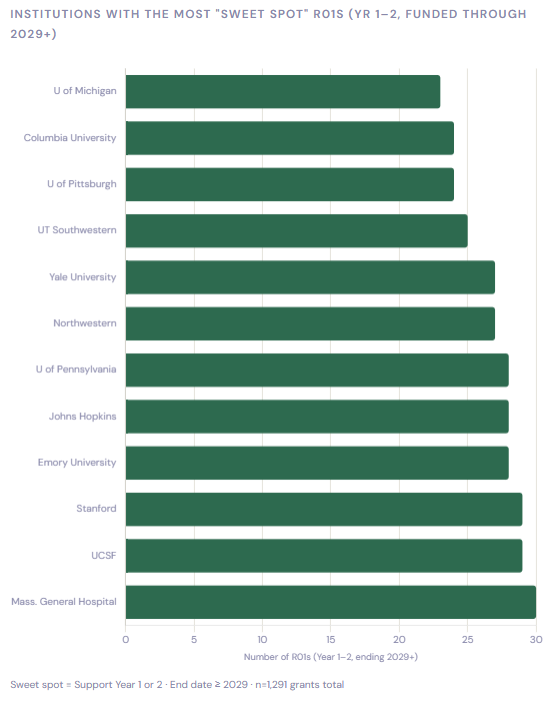
If you want to be systematic about this, look specifically for advisors in Year 1 or 2 of an R01 that runs through 2029 or later. These labs either just received a brand-new grant or just completed a successful renewal — meaning you could realistically complete your entire PhD within that funding window.
In the FY2026 data, there are 1,291 grants that meet this criteria. Here are the institutions with the most:
Institution Stability Rates: Volume vs. Proportion
Raw grant counts favor large schools. But for an individual applicant, the proportion of an institution's grants that are stable matters more than the total number — because it tells you what you're likely to encounter when you randomly land in a lab there.
UT Southwestern (46%), Northwestern (47%), Stanford (40%), and Massachusetts General Hospital (41%) stand out not just for the volume of stable grants but for having the highest proportions — meaning a larger share of their active labs are in early, freshly-funded cycles right now.
Duke (23%) and UC San Diego (25%) have strong overall numbers but lower stability proportions, suggesting their active grant portfolio skews toward mid-to-late cycle.
How to Look Up Any Advisor in 5 Minutes
The data above gives you the landscape. Here's how to apply it to a specific professor you're interested in:
-
Go to NIH RePORTER — Visit reporter.nih.gov and run a NIH reporter search by PI last name. Filter for "Active" projects.
-
Find the grant type — Look for R01, R35, or P01 grants. These are the primary mechanisms that fund PhD student research. Ignore expired grants.
-
Read the Project End Date — If the end date is in 2026 or early 2027 and it's their only grant, take note. That's a conversation to have before committing.
-
Check the Support Year — Year 1–2 = great. Year 3–4 = fine. Year 5 = ask about renewal status. Year 6+ = probably a center or program grant — more stable but worth understanding.
-
Look for multiple grants — An advisor with 2+ active grants is buffered. If one doesn't renew, the lab doesn't collapse overnight.
-
Ask directly — See below.
On Asking Your Advisor About Money
Here's the part nobody tells you: it feels awkward. You've been taught to present yourself as intellectually passionate, not financially calculating. Asking "what's your funding situation?" can feel like you're treating a mentorship like a job negotiation.
But here's the reframe: asking about funding is a sign of maturity, not mercenary thinking. Experienced advisors — the ones who've watched students struggle through mid-PhD funding crises — will respect the question. It signals that you understand how academic science actually works, and that you're thinking seriously about the commitment you're both making.
A professor who is offended by the question, or who gives you a vague non-answer, is actually telling you something important about how they communicate with students under pressure. How you engage with a potential advisor before joining — including publishing with faculty — also shapes how they perceive your seriousness as a candidate.
What to say: "I'm really excited about the research direction in your lab. Before I commit, I want to make sure I understand the funding picture — what does your grant situation look like over the next 3–4 years?" That's a professional question. Ask it.
What This Data Doesn't Show
-
Startup funds are invisible here. Junior faculty often have 2–3 years of institutional startup funding before they receive their first NIH grant. A lab with no NIH grants yet isn't necessarily unfunded — but that runway is finite and not publicly trackable.
-
Pending grants aren't in this data. An advisor might have a grant under review right now. "I have a renewal pending" is a real and legitimate answer — just not guaranteed funding until it's awarded.
-
Renewal rates are roughly 50%. A Year 5 advisor is not certain to lose funding. Half of renewal applications succeed. But it's uncertainty, and you deserve to know it exists.
-
This is a March 2026 snapshot. NIH RePORTER is continuously updated. Any analysis you do directly on the site will be more current than this post.
-
Grant size ≠ PhD stipend. The dollar amounts in NIH grants cover equipment, personnel, and indirect costs. Your PhD stipend is set by your institution's training program, not directly by grant size — though a lab under sustained funding pressure affects whether your advisor can maintain the headcount and resources that make productive research possible.
The Bottom Line
PhD advisor funding stability is one of the most important factors in your graduate school experience and one of the least discussed during the application process. The data is public, it takes five minutes to check, and it could save you years of avoidable stress.
About one in three active R01s runs through 2029 or beyond — these are the labs where incoming students have the most predictable financial footing for a full PhD timeline. Another 55% are mid-range, which is workable but worth investigating. And 13% expire this year, which should trigger a direct conversation before you commit.
Research fit still matters most. But a great match with unstable funding is a harder situation than a good match with a clear 5-year runway. Use both lenses.
Data & methodology: Analysis based on NIH RePORTER FY2026 export of 11,667 active grants, exported March 23, 2026. Stability analysis covers R01 activity codes only unless otherwise noted. "Stable" is defined as Project End Date ≥ January 1, 2029. "Sweet spot" grants are defined as Support Year 1 or 2 with end date ≥ 2029. Domain classifications follow NIH Institute activity codes. This analysis reflects a point-in-time snapshot; NIH RePORTER is updated continuously.
 Streamlined AI