How Long Does It Take to Get a PhD? Complete Timeline Guide
● phd · 15 min read
How Long Does It Take to Get a PhD? Complete Timeline Guide
PhD timelines by field and country: understand coursework duration, dissertation phases, and the factors that determine how long your doctorate actually takes.
A
Amos Oppong
Last Updated
If you're considering pursuing a doctoral degree, one of your first questions is likely: "How long does it take to get a PhD?" The answer depends on multiple factors—your field of study, country of enrollment, prior education, and whether you study full-time or part-time. This comprehensive guide breaks down realistic PhD timelines to help you plan your academic journey.
Quick Answer: PhD programs typically take 5-7 years in the United States and 3-4 years in the UK/Europe. The median time to complete a doctorate is 5.7 years, with humanities taking longest (7+ years) and engineering fastest (5.3 years). Having a master's degree can reduce your timeline by 1-3 years.
Quick Overview: Average PhD Duration
According to the 2023 Survey of Earned Doctorates from the National Center for Science and Engineering Statistics (NCSES), PhD students spend a median time of 5.7 years working toward their doctorate. However, when accounting for total graduate school time (including time spent completing any required master's degree), doctoral students spend a median of 7.2 years in graduate education.
Turn this research interest into an advisor shortlist.
Search more than one million faculty profiles by topic, institution, and country. Start with this article’s topic or enter your own.
PhD Duration by Country and Program Structure
The length of a PhD program varies significantly based on where you pursue your degree. Understanding these regional differences helps you plan accordingly.
United States: 5-7 Years (Full-Time)
In the U.S., PhD programs typically require 5 to 7 years of full-time study. The extended timeline reflects a comprehensive structure that includes:
Years 1-2 (or 1-3): Intensive coursework and qualifying examinations
Years 3-5: Dissertation research, data collection, and analysis
Final year: Writing, dissertation defense, and publication preparation
Students who enter with a master's degree can often reduce this timeline to 3-5 years by bypassing some coursework requirements. However, many U.S. PhD programs admit students directly from bachelor's degrees, making the longer timeline standard.
United Kingdom and Europe: 3-4 Years
UK and European PhD programs are typically 3 to 4 years in duration. These programs differ from U.S. models in several key ways:
Most require a master's degree for admission
Students begin dissertation research immediately
Coursework is minimal or non-existent
Programs are more tightly structured with clear milestones
According to Coursera's PhD guide, this streamlined approach allows students to focus exclusively on research from day one.
Australia and Other Regions
Australian PhD programs follow a similar 3-4 year model to the UK and Europe, with research-focused structures and master's degree prerequisites. Other regions vary, but most align with either the U.S. or European models.
PhD Timeline by Academic Field
Your chosen discipline significantly impacts how long your PhD will take. The American Academy of Arts and Sciences provides detailed data on completion times across fields.
PhD Duration by Field
Field
Median Duration
Key Factors
Engineering
5.3 years
Structured projects, industry partnerships
Life Sciences
5.7 years
Collaborative labs, shared equipment
Physical Sciences
5.9 years
Measurable milestones, team research
Social Sciences
6.8 years
Extensive coursework (4 yrs avg), IRB approvals
Humanities
7.1 years
Extended coursework, solo research model
STEM Fields: 5-6 Years
Engineering: Approximately 5.3 years (shortest median)
Structured research projects with clear endpoints
Industry partnerships often provide defined timelines
Access to lab resources and research teams
Physical Sciences: Around 5.9 years
Lab-based research with measurable milestones
Team collaboration speeds up data collection
Clear experimental frameworks
Life Sciences: Approximately 5.7 years
Experiment-based research with iterative processes
Access to shared lab facilities and equipment
Collaborative research environments
Social Sciences: 6-7 Years
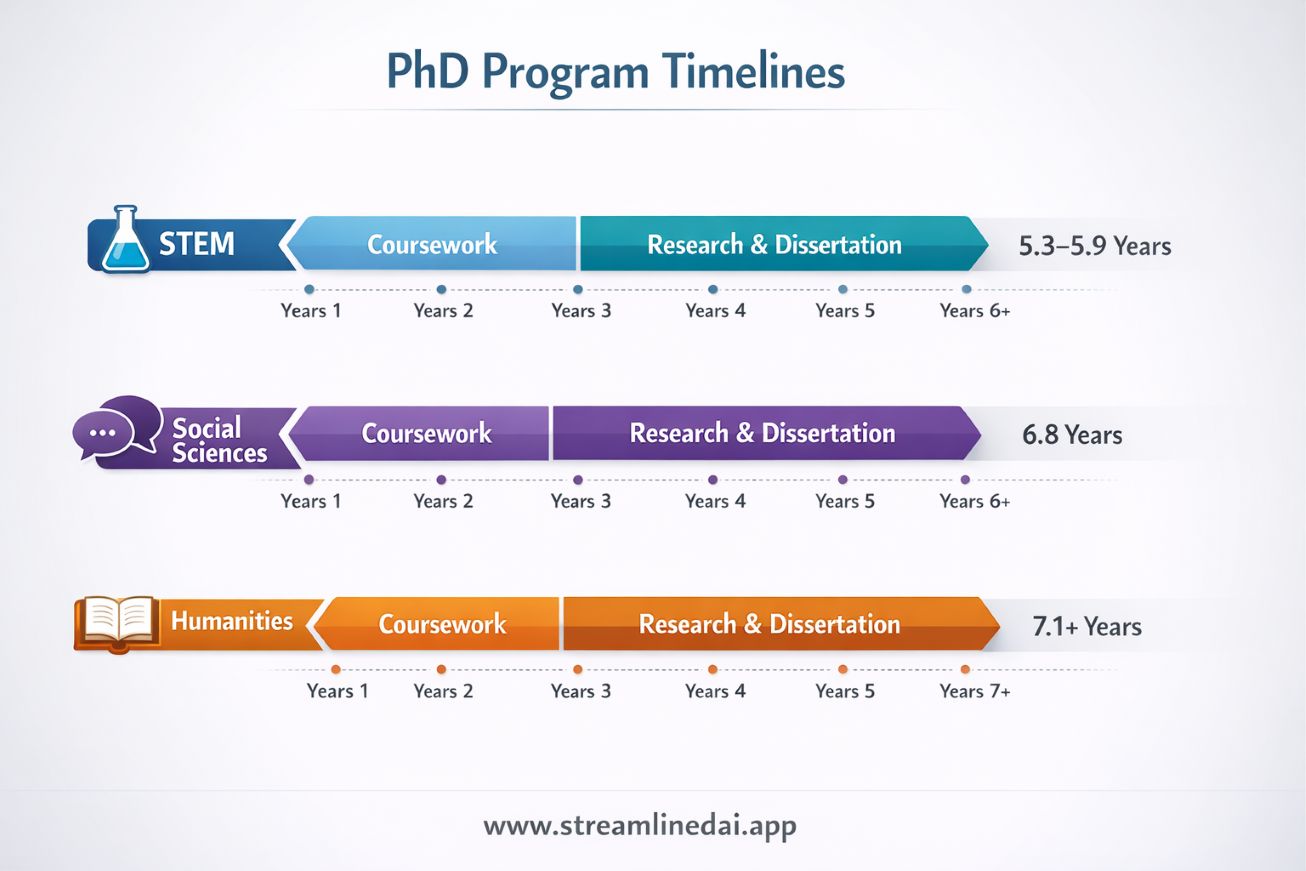
Social Sciences: Median 6.8 years
Extensive coursework requirements (4 years on average)
Complex data collection involving human subjects
IRB approvals can extend timelines
Dissertation phase similar to other fields (3 years)
Humanities: 7+ Years
Humanities and Arts: Median 7.1 years (up to 9.0 years for 2012 graduates)
The humanities consistently show the longest completion times. According to Inside Higher Ed's analysis, this is primarily due to:
Why Humanities Take Longer:
Extended coursework phase: Humanities and social sciences graduates spend a median of 4 years taking courses or preparing for comprehensive exams, compared to 2-3 years in natural sciences
Similar dissertation phase: The median time for dissertation work is roughly 3 years across all fields
Teaching requirements: Many humanities students work as teaching assistants, extending their timeline
Archival research: Travel for primary source research adds time
Solo scholarship model: Less collaborative research infrastructure than STEM fields
The PhD Journey: Phase-by-Phase Breakdown
Understanding the distinct phases of a PhD program helps you anticipate what lies ahead and plan accordingly.
Phase 1: Coursework and Comprehensive Exams (1-4 Years)
United States: 1-3 years of intensive coursework
Foundational courses in your field
Research methodology training
Seminar participation and presentations
Comprehensive qualifying examinations
Duration by field:
STEM: 2-3 years
Social Sciences: 3-4 years
Humanities: 3-4 years
UK/Europe: Minimal to no coursework (students begin research immediately)
Phase 2: Dissertation Proposal and Research (2-4 Years)
Across all fields and regions, dissertation research takes approximately 3 years:
Months 1-6: Literature review, proposal development, and committee formation
Months 6-12: Proposal defense and IRB/ethics approvals
Years 2-3: Active research, data collection, and preliminary analysis
Key milestones:
Thesis committee meeting approximately 3-6 months before defense
Regular progress meetings with advisors
Conference presentations to share preliminary findings
Submit dissertation drafts to committee members at least 2-3 weeks before defense
Schedule pre-defense meetings 3-6 months before final defense
Allow 10 weeks for multiple rounds of revisions before tentative defense date
Phase 3: Writing and Defense (6-12 Months)
The final phase involves:
Completing dissertation chapters
Committee review and revisions
Final oral dissertation defense (typically 2 hours)
Submitting the approved dissertation to the graduate school
Critical Timeline: Most universities require final dissertation submission within 60 days of completing the final exam. Submit drafts to committee members at least 2-3 weeks before defense, schedule pre-defense meetings 3-6 months before final defense, and allow 10 weeks for multiple rounds of revisions.
PhD program phases vary significantly by field, with humanities requiring longer coursework periods while STEM fields move to research faster.
Factors That Affect PhD Completion Time
Beyond field and country, several personal and institutional factors influence how long your PhD will take.
1. Prior Education and Experience
Master's Degree: Having a relevant master's degree can reduce PhD time by 1-3 years in the U.S. by allowing you to:
Skip or abbreviate coursework requirements
Enter with advanced research skills
Have a clearer dissertation topic
Research Experience: Prior research experience helps you navigate the dissertation phase more efficiently.
2. Full-Time vs. Part-Time Enrollment
Full-time students: Standard timelines apply (3-7 years depending on location and field)
Part-time students: According to BestColleges, part-time PhD programs often stretch to 6-7 years or longer, as students balance professional employment, family responsibilities, and limited research time per week.
3. Funding and Financial Support
Students with full funding (fellowships, assistantships, grants) typically complete faster because:
They can focus exclusively on research
They have access to necessary resources
Financial stress doesn't force extended timelines
Students working outside jobs to support themselves often take 1-2 additional years.
4. Nature of the Research
Research complexity dramatically affects timeline:
Faster Completion:
Computational or theoretical research
Access to existing datasets
Laboratory research with established protocols
Longer Completion:
Field research requiring travel
Longitudinal studies spanning multiple years
Research with difficult-to-access populations
Projects requiring extensive IRB approvals
5. Advisor Relationship and Mentorship
A supportive, engaged advisor who provides clear expectations and milestones, regular feedback on drafts, professional development opportunities, and reasonable timeline expectations is often the single most important factor in timely completion.
6. Institutional Policies
Time-to-degree limits: Most U.S. programs have maximum completion windows:
7 years for students entering with a BA
6 years for students entering with an MA
After this period, students may need special extensions or face automatic withdrawal.
Realistic PhD Timeline Planning
Based on the data, here's how to estimate your personal PhD timeline:
Calculate Your Expected Duration
Start with the field baseline:
Your Field
Baseline Duration
Engineering
5.3 years
Life Sciences
5.7 years
Physical Sciences
5.9 years
Social Sciences
6.8 years
Humanities
7.1 years
Adjust for these factors:
Factor
Adjustment
Have a master's degree
-1 to 2 years
Studying in UK/Europe
Use 3-4 year baseline
Part-time enrollment
+2 to 3 years
Complex field research
+0.5 to 1 year
Limited funding
+0.5 to 1 year
Setting Realistic Milestones
Year 1: Complete required coursework and identify potential advisors
Year 2: Finalize coursework, pass qualifying exams, form dissertation committee
Year 3: Defend dissertation proposal, begin active research
Years 4-5: Conduct research, collect data, present at conferences
Final year: Write dissertation chapters, defend, and submit
Is a Faster PhD Possible?
While some students complete PhDs in 3-4 years in U.S. programs, this is uncommon and typically requires:
Entering with a master's degree and clear research direction
Exceptionally supportive and available advisor
Access to existing datasets or resources
No funding gaps or external work requirements
Straightforward research questions with predictable outcomes
Important consideration: Rushing through a PhD can compromise depth of research, professional development, publication record (critical for academic careers), and mental health. The median completion time exists for good reasons—doctoral training develops not just research skills but also the intellectual maturity and professional networks essential for long-term success.
Frequently Asked Questions
How long does it take to get a PhD after a bachelor's degree?
In the United States, expect 5-7 years for full-time study. In the UK and Europe, you'll typically need to complete a master's degree first (1-2 years), then pursue a 3-4 year PhD, totaling 4-6 years from bachelor's completion.
Can you complete a PhD in 3 years?
Yes, in UK, European, and Australian programs where 3-4 years is the standard structure. In the U.S., 3-year completion is rare but possible if you enter with a master's degree, have a clear research plan, and face no major obstacles.
What is the shortest time to complete a PhD?
The shortest realistic timeline is 3 years in research-focused programs (UK/Europe) where you enter with a master's degree and exceptional preparation. Accelerated professional doctorates in some fields may be shorter, but traditional research PhDs rarely take less than 3 years.
How long is the dissertation phase of a PhD?
Across most fields, the dissertation phase typically runs about three years. A common pattern is roughly six months for proposal development, 18-24 months for research and data collection, and another 6-12 months for writing, revisions, and defense preparation. Timelines vary by advisor responsiveness, data access, and scope of the research question.
Why do humanities PhDs take longer?
Humanities PhDs take longer primarily due to extended coursework requirements (4 years vs. 2-3 years in sciences). The dissertation phase is similar across fields (3 years), but humanities students also face solo research models, archival work requiring travel, and heavier teaching loads.
Does having a master's degree shorten PhD time?
Yes, in U.S. programs, having a relevant master's degree can reduce PhD time by 1-3 years by allowing you to skip or abbreviate coursework. In UK/European programs, a master's degree is typically required for admission, so it doesn't shorten the PhD itself but is a prerequisite.
What percentage of PhD students finish in 5 years?
It varies significantly by field. Estimates often show higher five-year completion in some STEM areas (around 40-50%) and lower rates in many humanities or social science programs (around 20-30%), with large shares finishing in years six through eight. Use department-level placement and completion data whenever possible, since program variation is substantial.
How long is too long for a PhD?
Most U.S. institutions set a maximum of 6-7 years depending on entry credentials. Beyond this, students may face automatic withdrawal or need special extensions. From a career perspective, programs extending beyond 8-10 years can signal challenges that may affect future opportunities.
Making the PhD Timeline Work for You
Understanding that a PhD takes 5-7 years in the U.S. (or 3-4 years in other regions) helps you prepare mentally, financially, and professionally for the journey ahead. Here's how to approach your timeline strategically:
Before You Apply
Research typical completion times in your specific program and subfield
Connect with current students and recent graduates about realistic timelines
Consider whether entering with a master's degree makes sense for your goals
Evaluate your financial readiness for 5+ years of graduate study
During Your PhD
Set clear milestones with your advisor from day one
Track progress against benchmarks rather than arbitrary timelines
Build a support network of peers in similar stages
Prioritize mental health and work-life balance—burnout extends timelines
Stay connected to the job market in your field throughout your program
Managing Expectations
Remember that the median completion time means half of students take longer. External factors—research setbacks, advisor changes, funding gaps, personal circumstances—are normal parts of the doctoral journey. Building buffer time into your plans reduces stress and allows for the unexpected.
Your Next Steps
Ready to Start Your PhD Journey?
Now that you understand realistic PhD timelines, you can make informed decisions about your doctoral journey.
Key Takeaway: A PhD typically requires 5-7 years in the United States or 3-4 years in UK/European programs, with significant variation based on field, prior education, and personal circumstances. The journey is substantial, but for those with genuine passion for research and contributing new knowledge to their field, the investment opens doors to careers in academia, research, and specialized industry roles.
Remember: the timeline is just one factor in choosing whether to pursue doctoral education. The more important questions are whether you're passionate about research, prepared for the challenges, and clear about how the degree serves your long-term goals.
Amos Oppong is an entrepreneur leveraging AI applications to solve everyday problems. He is the brain behind Streamlined AI, a platform connecting students with academic advisors worldwide.
 Streamlined AI