 Streamlined AI
● masters · 17 min read
Master's in Psychology Guide (2026)
Master's in psychology guide: compare MA vs MS, program types from clinical to forensic, admission requirements, duration, and real salary data.
A
Amos Oppong
Published
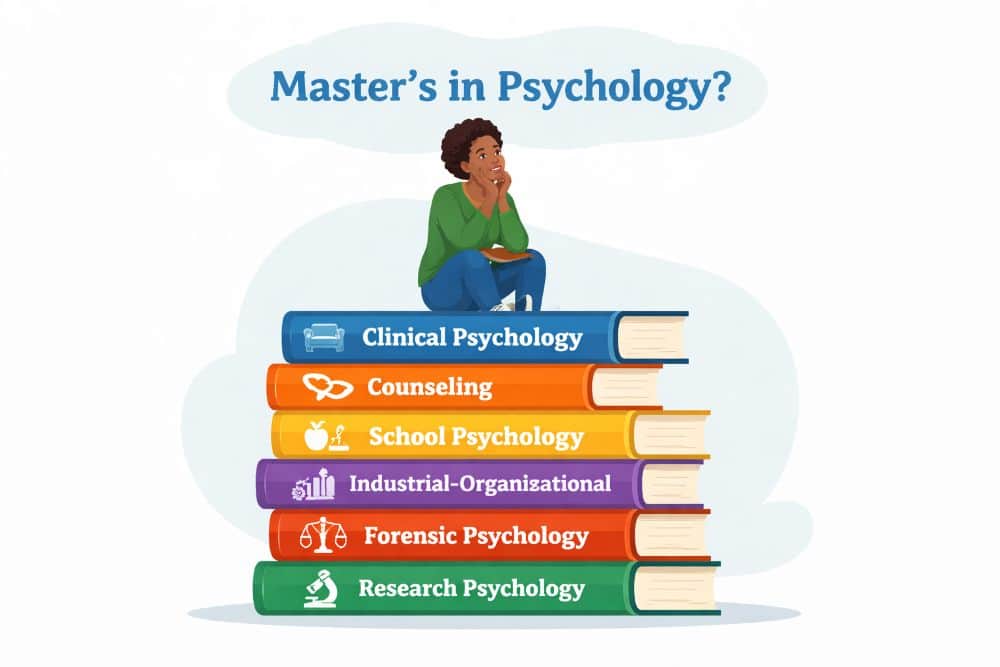
Master's in psychology guide: compare MA vs MS, program types from clinical to forensic, admission requirements, duration, and real salary data.
When I advise graduate applicants, the most common mistake I see around psychology master's degrees is assuming they are all the same. They are not. A master's in clinical psychology, a master's in industrial-organizational psychology, and a master's in experimental psychology are three very different programs with different requirements, different outcomes, and different licensing implications.
This guide is designed to remove that confusion. It covers every major program type, what admission committees actually look for, what the degree can and cannot do for your career, and how to make a decision that fits your actual goals — not just what looks prestigious on a shortlist.
Browse related topics on the Blog or explore Graduate School, Master's, and Career guides.
A master's in psychology is a postgraduate degree — awarded after a bachelor's — that provides advanced study in psychological theory, research methods, and applied practice. It sits one level below a doctoral degree (PhD or PsyD) and is typically required for licensure in several applied psychology fields, such as counseling and marriage and family therapy.
The degree comes in two main award types:
| Degree | Focus Emphasis | Typical Format |
|---|---|---|
| Master of Arts (MA) | Theory, humanities, social framework | Coursework, thesis or capstone |
| Master of Science (MS) | Empirical research, quantitative methods | Research-intensive, often thesis required |
The distinction matters less than you might think for most careers — employers typically care about your specialization and licensure status, not whether your degree is an MA or MS. The difference becomes more relevant if you plan to continue to a PhD, where an MS with a strong thesis can make you a more competitive applicant.
Put the insight to work
Search more than one million faculty profiles by topic, institution, and country. Start with this article’s topic or enter your own.
The specialization you choose is the most consequential decision in this process. Here is an evidence-based breakdown of the main program types.
Clinical psychology master's programs train students to assess and treat mental health disorders. Coursework covers psychopathology, evidence-based interventions, psychotherapy techniques, and clinical practicum placements.
Key consideration: In the United States, most states require a doctoral degree (PhD or PsyD) for independent licensure as a clinical psychologist. A master's in clinical psychology typically qualifies you for supervised practice under a licensed doctoral-level psychologist, or for licensure as a Licensed Professional Counselor (LPC) or similar credential — depending on your state and program structure. Note that the Licensed Clinical Social Worker (LCSW) credential requires a Master of Social Work (MSW) specifically, not a master's in psychology.
If private practice as a licensed clinical psychologist is your goal, a master's alone will not get you there in most U.S. states. Be clear on this before you apply.
Closely related to clinical psychology but with a traditional emphasis on wellness, career development, and working with functional populations rather than clinical disorders. The boundary between clinical and counseling has blurred in recent decades.
Programs often offer licensure pathways toward:
These are genuine, in-demand careers. The Bureau of Labor Statistics projects 22% growth in substance use and mental health counselor employment from 2022 to 2032 — much faster than average.
I-O psychology applies behavioral science to workplaces: employee selection, training and development, leadership assessment, organizational change, and workforce analytics. It does not require clinical licensure and is one of the most financially rewarding master's-level psychology careers.
The Society for Industrial-Organizational Psychology (SIOP) notes that I-O psychologists work in consulting, corporations, government agencies, and HR departments. Median pay for I-O psychologists with a master's routinely exceeds $90,000 in the U.S.
School psychologists work inside K–12 educational settings, assessing learning disabilities, supporting student mental health, and consulting with teachers and families. The dominant credential for this specialty is the Education Specialist (EdS) degree — a 60-credit, three-year program sitting between a master's and a doctoral degree — though many programs award both an MS and EdS.
The National Association of School Psychologists (NASP) sets training standards and governs the Nationally Certified School Psychologist (NCSP) credential, which many practitioners hold.
Forensic psychology applies psychological science to legal and criminal justice contexts: competency evaluations, risk assessment, trial consultation, victim services, threat assessment, and correctional rehabilitation. It is a growing field, partly fueled by popular media portrayals — but the work bears little resemblance to the dramatized "criminal profiling" of television. Real forensic psychology is grounded in psychometrics, clinical assessment, and legal standards.
Most forensic psychology roles require additional licensure or doctoral-level training for high-impact clinical-forensic work. At the master's level, graduates typically work in correctional settings, victim advocacy, or rehabilitation programs.
Research-focused programs train students in experimental design, statistics, and empirical methods. They are often stepping stones to doctoral study rather than end-goals in themselves. If you want to continue to a PhD program, a research master's with a published or near-published thesis is a very strong application asset.
Health psychology examines psychological factors in physical illness: how behavior, cognition, and stress affect conditions like chronic pain, cardiovascular disease, and cancer. Graduates work in hospital systems, rehabilitation centers, and public health settings.
While distinct from traditional psychology, many psychology departments offer ABA concentrations or standalone programs. Graduates pursue the Board Certified Behavior Analyst (BCBA) credential — in high demand for the treatment of autism spectrum disorder and developmental disabilities.
Admission requirements vary by program, but the following are near-universal elements.
| Requirement | Typical Standard |
|---|---|
| Bachelor's degree | Any field; psychology preferred but not always required |
| GPA | 3.0–3.5 minimum for most programs; competitive programs often see 3.5+ averages |
| Prerequisite coursework | Statistics and research methods are almost universal; abnormal and developmental psychology common |
| GRE scores | Test-optional at many programs; check each program individually |
The GRE situation has shifted substantially. As of 2024–2026, the majority of accredited master's programs in psychology have moved to test-optional or test-free admissions. Programs that retain GRE requirements tend to skew toward research-heavy and doctoral-prep tracks.
Personal Statement / Statement of Purpose
This is where most applications are won or lost. Admissions committees want to see:
Avoid generic statements about "wanting to help people." That tells an admissions reader nothing. Be specific about what draws you to this program — faculty research areas, clinical placement sites, program philosophy.
Letters of Recommendation
Most programs require 2–3 letters. For clinical and counseling programs, at least one letter from a supervisor who has observed you in a human services or mental health setting carries significant weight. For research-focused programs, letters from research supervisors who can speak to your empirical skills matter more.
Relevant Experience
Direct experience strengthens almost every application. This includes:
Some programs — particularly those with a strong clinical component — will not admit applicants without documented face-to-face experience with clients or research participants. Don't underestimate this requirement.
Transcripts and Writing Samples
Some research programs request a writing sample or undergraduate thesis. Writing samples are your chance to demonstrate analytic clarity — a strong sample reads like something almost ready for peer review.
Most master's in psychology programs run 1.5 to 3 years for full-time students, though this varies by specialization:
| Program Type | Typical Duration | Credit Hours |
|---|---|---|
| I-O Psychology (MA/MS) | 1.5–2 years | 36–48 credits |
| Clinical / Counseling (MA/MS) | 2–3 years | 48–72 credits (includes practicum) |
| School Psychology (EdS) | 3 years | 60–75 credits |
| Forensic Psychology (MA/MS) | 1.5–2 years | 36–48 credits |
| Experimental / Research (MA/MS) | 2 years | 30–48 credits |
Most programs offer both:
Thesis track — You complete an original research project under faculty supervision. This route takes longer but produces a published-quality piece of scholarly work. It is almost essential if you plan to apply to PhD programs later. Many programs also allow thesis students to apply credits toward continuation to a doctoral program.
Non-thesis track — You complete a capstone project, comprehensive exam, or applied practicum in lieu of a thesis. This is appropriate if you are entering practice directly after graduation and do not plan to pursue a doctorate.
Choose the thesis track unless you have a concrete reason not to. Even in applied fields, the ability to design and execute original research makes you a meaningfully stronger professional.
The number of accredited online master's in psychology programs has grown substantially since 2020. Here is how to think about the trade-off:
| Dimension | Online | In-Person / Hybrid |
|---|---|---|
| Flexibility | High — suits working professionals | Lower — class schedules are fixed |
| Cost | Often lower tuition; no relocation costs | May be higher; campus facilities included |
| Networking | Largely self-directed | Organic, cohort-based |
| Practicum / Clinic access | Arranged locally by student | Built into program structure |
| Research mentorship | Limited synchronous access to faculty | Direct, office-hours access to advisors |
| Accreditation risk | Variable — verify APA or CACREP status | Easier to verify on-site |
The critical check: If your program leads to licensure (LPC, LMHC, MFT, school psychologist), verify that online credits are accepted by your state licensing board. This is non-negotiable. Some states have nuanced or restrictive policies around online practicum hours. Check the licensing board in the state where you intend to practice, not just where the university is located.
For I-O psychology and research tracks, online programs can be entirely appropriate, as the outcome is professional employment rather than state licensure.
This is where the decision becomes concrete. Here is an honest career-by-career breakdown using the best available 2025–2026 data.
After completing a counseling master's and required supervised hours, you can pursue licensure as an LPC, LMHC, or equivalent. Licensed therapists work in community mental health centers, outpatient clinics, hospitals, schools, or private practice.
MFT is a distinct licensed specialty focusing on relational and systemic therapy. Programs must be accredited by COAMFTE (Commission on Accreditation for Marriage and Family Therapy Education) for licensure eligibility in most states.
I-O psychologists at the master's level work in HR analytics, talent management, leadership development, and organizational consulting. The role is high-demand, relatively well-compensated, and does not require clinical licensure.
Per the APA's own data, master's-level I-O practitioners are well-represented in the field — this is one of the few psychology specialties where a master's is a genuine, not provisional, career entry point.
School psychologists must hold a specialist-level credential (EdS or equivalent) in most states and meet NASP or state licensing requirements.
Forensic psychology roles at the master's level include correctional counselor, victim advocate, rehabilitation specialist, and court-appointed case manager. High-stakes clinical-forensic work (competency evaluations, expert testimony) typically requires doctoral-level licensure.
With a master's in applied behavior analysis and the BCBA credential, graduates are among the most in-demand psychology professionals in the current market, driven by demand for autism treatment services.
Master's-level health psychologists typically work within larger healthcare teams in hospitals, rehabilitation settings, or public health programs.
Graduates of research-focused master's programs often work as research coordinators, data analysts, or lab managers — primarily in universities, government research agencies, or contract research organizations. These roles are frequently positioned as stepping stones toward doctoral applications.
Based on the data and the conversations I have with applicants, the answer is: yes — if you have a specific goal it clearly serves, and no — if you are hoping it will solve an unclear career decision.
Here is the framework I use in advising:
A master's in psychology is a strong choice when:
A master's in psychology is the wrong choice when:
The tuition reality: U.S. master's programs in psychology are frequently self-funded, unlike many PhD programs which offer stipends and tuition waivers. A two-year program can cost $30,000–$80,000+ in tuition alone. Run the numbers against realistic starting salaries before you commit.
Before submitting applications, verify the following for each program you are considering:
Yes. Many programs accept applicants from other bachelor's disciplines, often with prerequisites (statistics, research methods, introductory psychology). Some programs offer prerequisite coursework concurrently with the degree. Your application will need to demonstrate why you are transitioning and how your background is relevant.
In 2026, most programs are test-optional. A minority of research-focused or doctoral-prep programs still recommend or require GRE scores. Check each program individually — do not assume.
Both are doctoral degrees, not master's. The PhD is a research doctorate; the PsyD (Doctor of Psychology) is a professional practice doctorate oriented toward clinical work. Neither is the same as a master's degree — they require additional years of training beyond a master's.
In most U.S. states, no. The title "psychologist" and independent practice rights typically require a doctoral degree plus supervised hours and state licensure. Master's graduates practice under licensed doctoral supervisors in clinical settings, or under specific licensed credentials (LPC, LMHC, MFT) that carry their own independent practice rights after supervised hours.
Check your specific state's licensing board, as a small number of states do offer some form of master's-level licensure as a psychological associate or similar designation.
Most full-time students complete a master's in 1.5–3 years. Clinical and school psychology programs take longer because of required practicum and internship hours. Part-time or online programs may extend to 3–4 years.
Generally yes, provided the program is accredited and the employer recognizes the credential. For licensure-track programs, what matters most is whether your state licensing board accepts the program — not the delivery modality itself. For non-clinical roles (I-O, HR, research), an accredited online degree is widely accepted.
A master's in psychology is one of the more versatile postgraduate credentials in the social sciences — but it demands strategic selection. The degree you earn will largely be defined by the specialization, the accreditation status, and the licensure pathway it provides or forecloses.
The most important step you can take before applying is to talk directly with master's-level practitioners in the role you want to occupy — not just admissions advisors, not just program websites. Ask them what credential they needed, how their degree prepared them, what they wish they had known, and whether they would make the same choice again. That conversation will tell you more than any ranking.
If you are also navigating the master's vs PhD decision, the Master's vs PhD guide breaks down that comparison in detail. And if funding is a concern, explore the overview of doctoral fellowships — some competitive master's programs also award fellowship funding.
Note: Salary figures in this guide draw primarily from the U.S. Bureau of Labor Statistics Occupational Employment and Wage Statistics (2023 data) and BLS Occupational Outlook Handbook projections (2022–2032). Licensing requirements vary by state; always verify current requirements with your state licensing board before choosing a program. Last verified: March 21, 2026.