Global Perspective: Percentage of Population with PhD Worldwide
The percentage of people with a PhD varies significantly across countries, reflecting different educational systems, economic development, and cultural attitudes toward advanced education.
How Many People Have a PhD Globally?
Estimating the global percentage of PhD holders is challenging due to varying data collection methods and definitions across countries. However, research suggests:
- Global average: Approximately 0.5-1.0% of the world's adult population holds a doctoral degree (estimated)
- OECD countries: Average of 1.5-2.5% of adults aged 25-64 have doctoral degrees
- Developing nations: Often below 0.5% of the population
Note: Global estimates are approximate due to inconsistent reporting standards and varying definitions of doctoral degrees across countries.
Country Comparisons
Different nations show vastly different PhD attainment rates (approximate figures based on OECD Education at a Glance 2023 and national statistics):
High PhD Attainment:
- Switzerland: ~2.5% of adults aged 25-64 (estimated)
- Slovenia: ~2.5-3.0% (estimated)
- Luxembourg: ~2.5% (estimated)
- United States: ~2.0%
- United Kingdom: ~1.8%
Moderate PhD Attainment:
- Germany: ~1.6%
- Australia: ~1.5%
- Canada: ~1.4%
- Sweden: ~1.3%
Lower PhD Attainment:
- China: ~0.5% (estimated; though producing the most PhDs annually)
- India: ~0.3% (estimated)
- Brazil: ~0.2% (estimated)
Note: Developing nation figures are estimates and may not reflect recent growth in doctoral education.
These differences reflect factors including:
- Length and structure of doctoral programs
- Funding availability
- Academic job market conditions
- Cultural valuation of research careers
- Economic development levels
Demographic Breakdown: Who Earns PhDs in America?
Understanding the percentage of people with a PhD becomes more nuanced when we examine specific demographic groups. These statistics reveal important patterns in educational access and achievement.
PhD Attainment by Age
Doctoral degree attainment varies by age cohort, reflecting both the time required to earn the degree and generational trends:
- 25-29 years: ~0.5% (many still completing degrees)
- 30-34 years: ~1.2%
- 35-44 years: ~2.1%
- 45-54 years: ~2.3%
- 55-64 years: ~2.2%
- 65+ years: ~1.9%
The median age at which Americans earn their PhD is approximately 31-33 years, though this varies significantly by field.
PhD Attainment by Gender
The gender composition of PhD holders has shifted dramatically over recent decades:
Current Distribution (2022 Census data):
- Men: 2.2% of adult males hold a PhD
- Women: 1.8% of adult females hold a PhD
However, recent trends show convergence:
- In 2022, women earned 47% of all research doctorates awarded in the U.S. (and 52% among U.S. citizens and permanent residents)
- This represents a historic shift from 1970, when women earned only 14% of PhDs
- Fields like biological sciences, social sciences, and education now grant more PhDs to women than men
- STEM fields (particularly engineering and computer science) still skew male, though the gap is narrowing
Source: NSF Survey of Earned Doctorates 2022; U.S. Census Bureau ACS 2022
PhD Attainment by Race and Ethnicity
Significant disparities persist in doctoral degree attainment across racial and ethnic groups (2022 data):
- Asian Americans: ~4.8% hold doctoral degrees
- White Americans: ~2.3%
- Black or African Americans: ~1.1%
- Hispanic or Latino Americans: ~0.8%
- Native American/Alaska Native: ~0.7%
Source: U.S. Census Bureau ACS 2022. Note: Asian American category includes diverse ethnic groups with varying educational attainment patterns.
These disparities reflect systemic barriers including:
- Unequal access to quality undergraduate education
- Financial constraints during lengthy doctoral programs
- Lack of representation and mentorship
- Structural racism in academic institutions
Efforts to increase diversity in doctoral education remain a critical priority, with many institutions implementing targeted recruitment, funding, and support programs.
PhD Attainment by Field of Study
The concentration of PhD holders varies dramatically by field (based on 2022 doctoral awards):
Highest PhD Production Fields:
- Engineering: ~20% of all PhDs awarded
- Life Sciences: ~16%
- Physical Sciences: ~10%
- Social Sciences: ~9%
- Psychology: ~7%
- Education: ~7%
- Humanities: ~6%
Smallest Fields:
- Mathematics/Statistics: ~4%
- Computer Sciences: ~4.5%
- Business: ~3%
Note that field popularity has shifted over time, with computer science PhDs growing rapidly while humanities PhDs have declined.
Source: NSF Survey of Earned Doctorates 2022
Trends Over Time: Is the Percentage Increasing?
The percentage of Americans with PhDs has grown steadily over the past several decades, though the rate of growth has varied.
Historical Growth Patterns
- 1980: ~1.0% of adults had doctoral degrees
- 1990: ~1.2%
- 2000: ~1.5%
- 2010: ~1.8%
- 2020: ~2.0%
- 2022: ~2.0%
This represents a doubling over 40 years, though growth has plateaued recently.
Source: U.S. Census Bureau, Historical Educational Attainment Tables. Figures are rounded estimates from decennial census and American Community Survey data.
Annual PhD Production
The United States awards approximately 55,000-58,000 research doctorates annually (over 57,000 in 2022), according to the National Science Foundation's Survey of Earned Doctorates.
Key trends include:
- International students on temporary visas earn approximately 30-35% of U.S. PhDs
- STEM fields account for roughly 75-80% of all doctorates
- Average time to degree has stabilized at 5-7 years depending on field (median 6 years overall in 2022)
- Post-doctoral positions have become increasingly common, extending the training period
Source: NSF Survey of Earned Doctorates 2022
Future Projections
Based on current trends, modest continued growth in PhD attainment appears likely:
- By 2030, an estimated 2.2-2.3% of Americans may hold doctoral degrees (assuming current production rates)
- Growth will likely be driven by increasing demand for advanced skills in technology, healthcare, and research
- However, concerns about PhD job markets, student debt, and long training periods may constrain growth
Note: Projections are extrapolations based on current trends and should be treated as estimates rather than forecasts.
Why Does the Percentage Matter?
Understanding how many people have a PhD provides valuable context in several areas:
1. Career Planning and Competitiveness
Knowing that only 2% of Americans hold PhDs helps prospective students understand:
- The exclusivity and value of the credential
- Competition levels in academic and research careers
- The distinctive skills that set PhD holders apart
- Whether the investment of 5-7 years is aligned with career goals
2. Policy and Workforce Development
Policymakers use these statistics to:
- Project needs for highly skilled workers in research and development
- Design funding for doctoral education and research
- Address equity gaps in advanced education access
- Plan immigration policies for attracting international talent
3. Research and Innovation Capacity
PhD attainment rates correlate with:
- National research output and innovation
- Patent production and technological advancement
- Scientific publication volume
- Economic competitiveness in knowledge industries
Countries with higher PhD attainment rates generally show stronger research and development ecosystems.
4. Understanding Social Mobility
PhD statistics illuminate patterns of educational mobility:
- First-generation college graduates face additional barriers to doctoral education
- Socioeconomic background significantly influences PhD attainment likelihood
- Geographic location affects access to doctoral programs
- Financial aid availability determines who can afford the opportunity cost
How Does a PhD Compare to Other Advanced Degrees?
To fully understand what percent of people have a PhD, it helps to compare doctoral degrees to other graduate credentials:
Master's Degrees
- Percentage of Americans: ~13.7%
- Ratio: About 7 master's degrees are awarded for every PhD
- Time to complete: Typically 1-2 years
- Focus: Advanced professional skills and specialized knowledge
Professional Degrees (MD, JD, DVM, etc.)
- Percentage of Americans: ~2.4%
- Ratio: Slightly more common than research doctorates
- Time to complete: Typically 3-4 years post-bachelor's
- Focus: Practice in specific professional fields
Comparison Summary
A PhD remains rarer than a master's degree but comparable in prevalence to professional degrees. However, PhDs require:
- Longer time commitments (5-7 years vs. 1-4 years)
- Original research contributions
- Dissertation defense
- Training in research methodology and academic scholarship
The distinct nature of the PhD—focused on creating new knowledge rather than applying existing knowledge—makes it fundamentally different from other graduate degrees.
Regional Variation: PhD Attainment Across U.S. States
The percentage of people with PhDs varies considerably across U.S. geography (2022 ACS data):
States with Highest PhD Attainment
- District of Columbia: ~8.5% (influenced by federal research agencies)
- Massachusetts: ~3.8% (concentration of research universities)
- Maryland: ~3.6% (proximity to federal research centers)
- Connecticut: ~3.3%
- Vermont: ~3.2%
States with Lowest PhD Attainment
- West Virginia: ~1.0%
- Arkansas: ~1.1%
- Mississippi: ~1.2%
- Nevada: ~1.2%
- Louisiana: ~1.3%
Source: U.S. Census Bureau, American Community Survey 2022 state-level estimates
These regional differences reflect:
- Concentration of research universities and institutions
- Presence of federal research facilities and national labs
- State investment in higher education
- Economic opportunities for PhD holders
- Migration patterns of highly educated workers
The Bottom Line: How Rare Is a PhD?
Let's answer the core question directly with context:
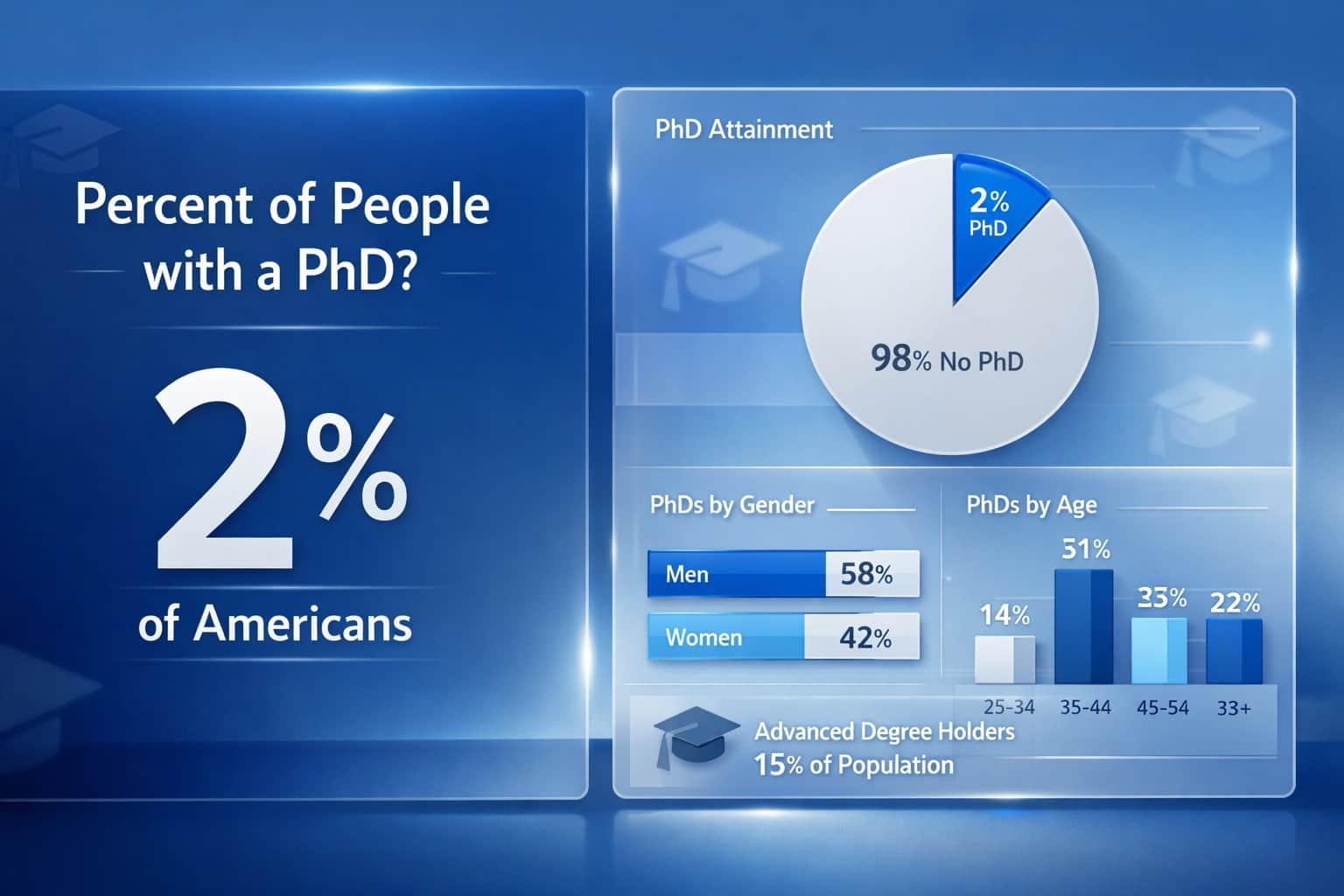
In the United States: Only 2 out of every 100 adults hold a doctoral degree. This makes PhD holders a small, elite group representing the highest level of educational achievement.
Globally: The percentage drops to approximately 0.5-1.0% (estimated), making PhDs even rarer on the world stage.
Among college graduates: Even among those who earn bachelor's degrees, only about 5% will eventually complete a PhD.
What This Means for You
If you're considering a PhD:
- You would join a select 2% of the population with this credential
- Your expertise would be rare and valuable in research, academia, and specialized industries
- The commitment is substantial but the credential remains prestigious and professionally significant
- Market dynamics matter—some fields have strong demand for PhDs, others face oversupply
If you hold a PhD:
- Your achievement is statistically exceptional and represents years of dedicated scholarly work
- Your training provides distinctive capabilities in research, critical analysis, and specialized knowledge
- You are part of the community that drives innovation and knowledge creation globally
Beyond the Numbers: The Value Proposition
While understanding what percentage of people have a PhD provides useful context, the decision to pursue one should extend beyond statistics. Consider:
The PhD Is Right For You If:
- You have genuine passion for research and inquiry
- You want to contribute original knowledge to your field
- You seek careers in academia, R&D, or specialized research
- You're prepared for 5-7 years of intensive study
- You can manage financial constraints during the training period
The PhD May Not Be Right If:
- Your primary goal is income maximization (ROI varies significantly)
- You're pursuing it to delay career decisions
- You lack specific research interests
- You prefer applied work over theoretical research
- You're responding to external pressure rather than internal motivation
Conclusion: A Rare But Achievable Credential
The statistics are clear: only 2% of Americans and approximately 1% of people globally hold doctoral degrees. This rarity reflects the substantial commitment, rigorous standards, and specialized nature of PhD training.
However, these numbers also reveal opportunity. With over 57,000 PhDs awarded annually in the U.S. alone, thousands of individuals successfully complete this journey each year. The demographic trends show increasing diversity and evolving field preferences, suggesting the doctoral education landscape continues to adapt.
Whether you're evaluating your own educational path, advising students, or simply satisfying curiosity, understanding that PhDs remain rare but attainable provides important context. The 2% figure represents not just exclusivity, but the collective expertise of millions of individuals who have pushed the boundaries of human knowledge.
If you're considering joining their ranks, base your decision on passion for research, clear career goals, and realistic understanding of the commitment involved. The statistics show that a PhD remains one of the most prestigious educational achievements—and one of the most transformative personal journeys you can undertake.
Frequently Asked Questions
How many people have PhDs in the world?
While exact global figures are difficult to determine due to inconsistent international reporting, rough estimates suggest approximately 40+ million people worldwide hold doctoral degrees, representing an estimated 0.5-1.0% of the global adult population. This estimate should be treated as approximate given data limitations.
What state has the highest percentage of PhDs?
The District of Columbia has the highest PhD attainment rate, at roughly 8.5% based on recent U.S. estimates. Its concentration of federal agencies, policy institutions, and research organizations drives that unusually high share. Among U.S. states, Massachusetts is typically the top performer at around 3.8%, reflecting strong university density and research employment.
Are PhDs becoming more common?
Yes, but growth is gradual rather than explosive. U.S. PhD attainment has risen from about 1.0% in 1980 to roughly 2.0% in recent data, and annual doctorate production now exceeds 57,000. Even with that increase, doctoral degrees remain rare in the general population, so prevalence is rising slowly from a low baseline.
What percentage of the population has a master's degree?
In the United States, about 13.7% of adults aged 25+ hold a master's degree, based on recent Census estimates. That makes master's attainment far more common than doctoral attainment, which is closer to 2.0%. The comparison is useful when evaluating education pathways, because master's degrees are broader in access, duration, and career application.
How does PhD attainment vary by field?
PhD production varies sharply by discipline. Engineering contributes the largest share of doctorates (around 20%), followed by life sciences (about 16%) and physical sciences (about 10%). Humanities, education, and business usually represent smaller shares. Field differences reflect labor demand, research funding levels, program capacity, and typical career pathways after graduation.
Do more men or women have PhDs?
Historically, men earned most PhDs, but as of 2022, women earn 47% of all research doctorates in the U.S. (52% among U.S. citizens and permanent residents). Among current PhD holders (all ages), men still slightly outnumber women (2.2% vs. 1.8%) due to historical trends.
What's the average age to complete a PhD?
In the United States, the median age at PhD completion is usually around 31-33 years. That average shifts by field, prior work experience, and entry pathway. STEM candidates often finish younger because of tighter lab structures, while humanities and some social science programs can run longer due to archival work, teaching demands, and dissertation scope.
Is a PhD worth it financially?
Lifetime earnings for doctoral degree holders vary significantly by field, but some estimates suggest cumulative earnings of $3.4+ million on average—roughly 25-30% more than bachelor's degree holders in comparable fields. However, ROI varies dramatically by discipline (STEM vs. humanities), and the 5-7 year opportunity cost plus potential student debt must be considered.
Note: Earnings estimates are based on median lifetime earnings projections and vary widely by field, industry, and career path. Sources include Georgetown University Center on Education and the Workforce and U.S. Census Bureau earnings data.
Ready to pursue your PhD? Explore our comprehensive guide to PhD programs and find the right advisor for your research journey on StreamlinedAI.
 Streamlined AI